Austria Invoice Template (Rechnung): § 11 UStG Field Reference
This is an editable layout for an Austrian invoice (Rechnung) under § 11 of the Umsatzsteuergesetz 1994 (UStG). A full invoice needs your name and address and the customer's, the quantity and usual description of the goods or the type and extent of the service, the date or period of supply, the net amount and the USt rate (or a note that an exemption applies), the USt amount, the issue date, a sequential invoice number and your UID-Nummer. If the total exceeds €10,000 and you invoice another business from Austria, the customer's UID-Nummer is required as well. Austria accepts PDF and other electronic invoices between businesses when the customer agrees, so an invoice built from this layout, or made in InvoiceQuickly, can be a valid domestic invoice once every required detail is on it. The exception is federal government customers, who only accept structured e-invoices. The template downloads as an editable HTML file with a table that shows the USt rate on every line.
The HTML file opens in your browser so you can type over each field, then print or save it as a PDF. The PDF is a blank 2-page A4 form to print and fill in by hand; it is not a fillable PDF form. Totals are entered manually in both.
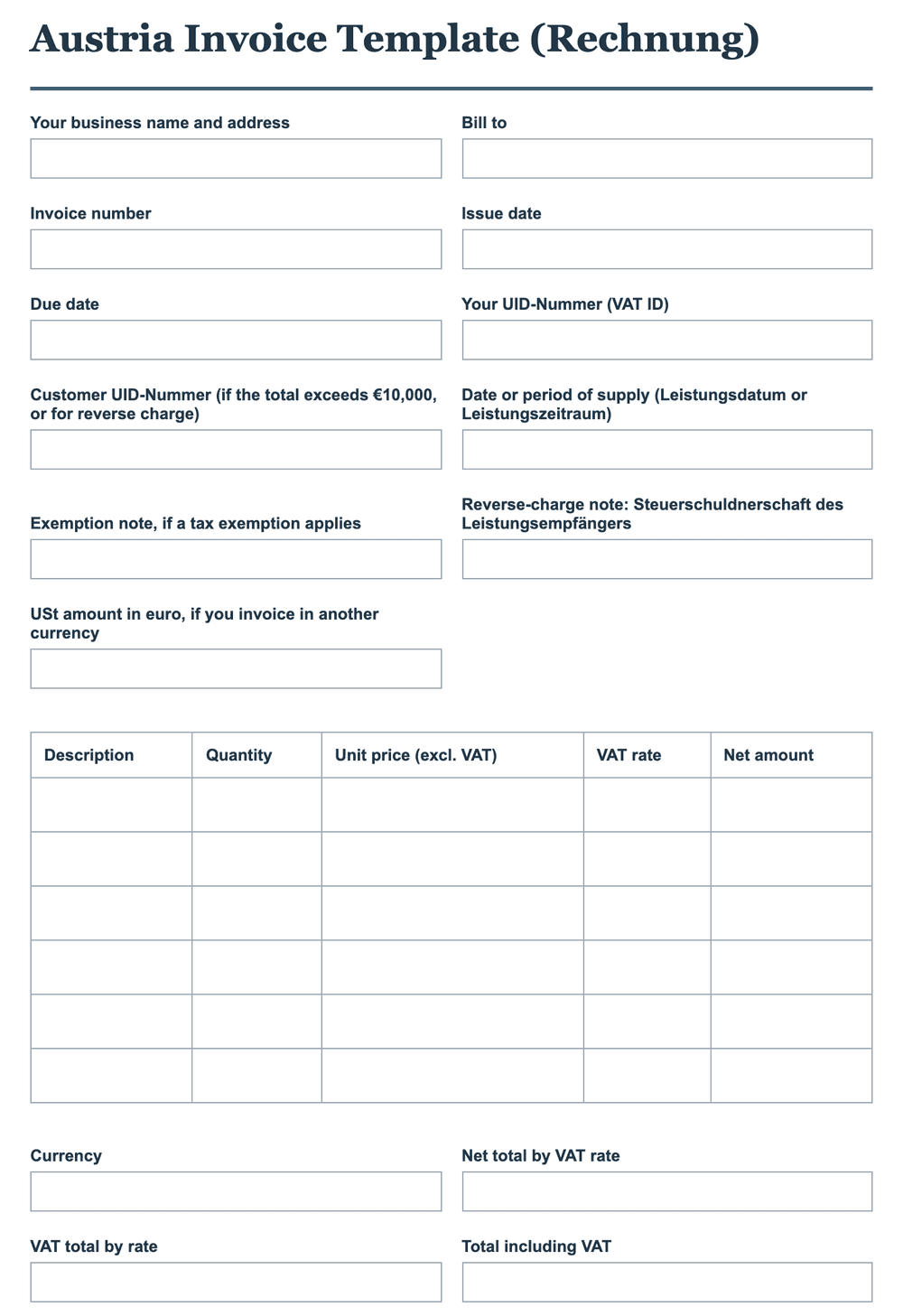
What This Template Includes
- Your UID-Nummer (VAT ID)
- Customer UID-Nummer (if the total exceeds €10,000, or for reverse charge)
- Date or period of supply (Leistungsdatum or Leistungszeitraum)
- Exemption note, if a tax exemption applies
- Reverse-charge note: Steuerschuldnerschaft des Leistungsempfängers
- USt amount in euro, if you invoice in another currency
How to Create Your Austria Invoice (Rechnung)
- 01
Describe your work
Type a plain English description of the services you provided, the client, and the amount.
- 02
AI generates your invoice
InvoiceQuickly's AI drafts the client, line items, dates, and totals for you to review before saving.
- 03
Review, download, and send
Check every detail, download the PDF, or use Pro to email the PDF directly to your client.
Recommended Payment Terms
State the payment term you agreed with the customer, for example "zahlbar innerhalb von 30 Tagen ab Rechnungsdatum" (payable within 30 days of the invoice date), with your IBAN and BIC. If you offer an early-payment discount (Skonto), write the percentage and the deadline, for example "2 % Skonto bei Zahlung innerhalb von 10 Tagen". Check the statutory default-interest rules with your adviser before you add a late-payment clause.
Need help writing payment terms? Read our guide to invoice payment terms for best practices and templates.
Tax Information
Under § 10 UStG the standard rate is 20%. Reduced rates are 13% (for example live plants, artistic activity and admission to sports events) and 10% (for example residential rent, accommodation, books, newspapers and food not covered by the 4.9% rate). Since 1 July 2026 a 4.9% rate applies to the basic foods listed in Annex 3 of the UStG, and only when the supply consists solely of those goods. An invoice that covers several rates must show the net amounts and tax separately for each rate (§ 11 Abs. 5). If you invoice in another currency, the USt amount must also be shown in euro. Small businesses under the exemption (Kleinunternehmer, turnover up to €55,000 a year) must not show any USt. InvoiceQuickly applies one tax percentage per invoice, so it fits single-rate invoices only. It copies your saved tax ID to new invoice PDFs and has no ebInterface or Peppol output.
Industry context (2026)
Austria's invoice rules sit in § 11 UStG 1994 (consolidated version of 17 July 2026 on RIS). A business that supplies another business must issue an invoice within six months of the supply and keep copies for seven years. Electronic invoices between businesses need the customer's consent but no particular format. Since 1 January 2014, federal government bodies accept only structured e-invoices through the Unternehmensserviceportal or Peppol. Since 1 July 2026, a fourth rate of 4.9% applies to the basic foods listed in Annex 3, so food sellers may need several rates on one invoice. The small-business exemption threshold rose from €35,000 to €55,000 from 2025 (BMF form U 12). At EU level, the VAT in the Digital Age package entered into force on 14 April 2025, with digital reporting for cross-border B2B transactions from 1 July 2030 (European Commission, accessed 27 October 2026).
Worked example
Huber Softwareentwicklung e.U., a sole trader in Vienna, builds an ordering module for Berger Maschinenbau GmbH in Linz in October 2026 (an illustrative example). Lines: development 80 hours at €110.00 = €8,800.00; deployment and handover workshop €600.00. Net amount €9,400.00, USt at 20% €1,880.00, total €11,280.00. Because the total exceeds €10,000 and the customer is a business, the invoice shows Berger's UID-Nummer as well as Huber's own, plus "Leistungszeitraum: 1.–31. Oktober 2026", the issue date and the next number in Huber's sequence. Huber issues it on 3 November 2026, well inside the six-month limit. In a small-amount variant, Huber charges a shop €300.00 net for a one-hour support call: USt at 20% is €60.00 and the gross total €360.00, under €400, so the invoice may show just the gross €360.00 and "inkl. 20 % USt", without the customer's address or an invoice number. In a reverse-charge variant, a €2,000.00 job for a company in Germany shows no USt, both UID-Nummern and a note on the Steuerschuldnerschaft des Leistungsempfängers.
Common mistakes to avoid
Leaving out the date of supply
The issue date is not enough. Add the delivery date or the period the service covers, or the customer's input-VAT deduction can be at risk.
Missing the customer's UID-Nummer above €10,000
For a business customer, an invoice total over €10,000 needs the customer's UID-Nummer as well as yours.
Showing USt as a Kleinunternehmer
Under the small-business exemption you must not show USt on your invoices. If you do, you owe the tax shown unless you correct the invoice.
Mixing rates without splitting them
Lines at 20%, 13%, 10% or 4.9% need net amounts and tax shown separately for each rate.
Emailing a PDF to a federal government body
Federal bodies only accept structured e-invoices through e-rechnung.gv.at or Peppol, so a PDF is not accepted.
Invoicing Tips
- 1Put your UID-Nummer on every full invoice. For an invoice over €10,000 to another business, add the customer's UID-Nummer too.
- 2Write the date or period of supply, not only the issue date. For services that run across a month, the period (for example "Leistungszeitraum: Oktober 2026") is enough.
- 3For an invoice up to €400 including USt, you may show only your name and address, the description, the supply date, the gross amount and the USt rate, plus the issue date. This simplified form is not allowed for invoices you must issue for supplies in other EU countries.
- 4When the customer owes the tax (reverse charge), show no USt amount, add the customer's UID-Nummer and point out the Steuerschuldnerschaft des Leistungsempfängers.
- 5Before you email invoices as PDF, make sure the customer agrees to electronic invoices, and keep a copy for seven years.
- 6For a federal government customer, enter the invoice through e-rechnung.gv.at in the Unternehmensserviceportal (USP) or send it over Peppol. A PDF is not enough there.
Related Resources
- Regional invoicing: Which countries need e-invoicing and what InvoiceQuickly supports
- What is the reverse charge?
- VAT invoicing guide
- Invoice requirements in Germany: For Austrian businesses that also invoice German customers
- All invoice templates
Frequently Asked Questions
What must an Austrian invoice include?
Under § 11 UStG: your name and address, the customer's name and address, the quantity and usual description of the goods or the type and extent of the service, the date or period of supply, the net amount and USt rate (or a note that an exemption applies), the USt amount, the issue date, a sequential number and your UID-Nummer. Above €10,000 to another business, add the customer's UID-Nummer.
What is a Kleinbetragsrechnung in Austria?
An invoice whose total, including USt, is no more than €400. Besides the issue date it only needs your name and address, the quantity and description, the supply date, the gross amount and the USt rate. The customer's details, the invoice number, the UID-Nummer and a separate USt amount can be left out. Small businesses using the Kleinunternehmer exemption may use the same simplified form.
Can I send a PDF invoice in Austria?
Yes, if the customer agrees to electronic invoices and the authenticity of origin, integrity of content and readability are ensured, for example through an internal control process with a reliable audit trail. If you send the same invoice in two forms, such as PDF and paper, mark it so the tax is not owed twice. Federal government bodies are the exception: they only accept structured e-invoices.
Is e-invoicing mandatory in Austria?
Only for suppliers to the federal government, since 1 January 2014, through e-rechnung.gv.at or Peppol. The USP pages (updated 1 January 2026) state that suppliers to the Länder and municipalities have no such obligation. Under the EU's VAT in the Digital Age package, digital reporting for cross-border B2B transactions starts on 1 July 2030.
Can InvoiceQuickly create Austrian invoices?
It can create single-rate PDF invoices in euro with your description, dates, net amount, USt rate and amount. New invoice PDFs print the UID-Nummer you save as your business tax ID and your customer's saved tax ID; you add the supply date and any exemption or reverse-charge note in the notes or terms. It cannot split rates on one invoice and has no ebInterface or Peppol output for government invoices.